
Tipping in 2026
it's gotten completely bonkers

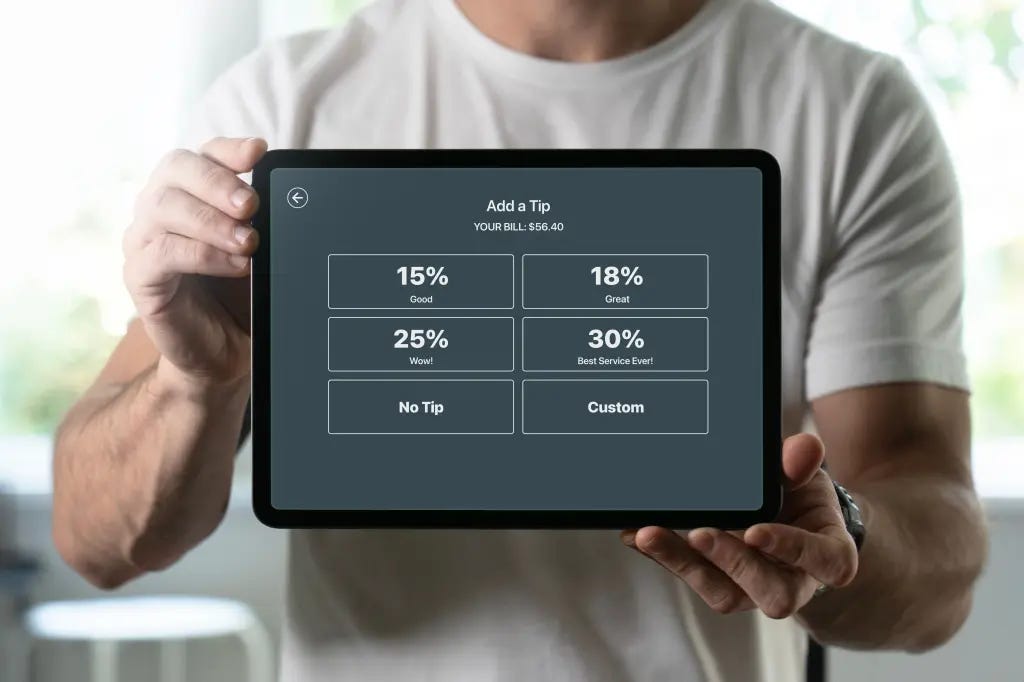
People have a lot of feelings about tipping lately.
I don’t blame them.
Back in the day (I love being old enough to say this and sound like a cliche), it used to be pretty well-defined who was supposed to be tipped. Over the last 20 years, though, and especially since digital payments have become so widespread, the space has become extremely confusing.
Articles are everywhere about how out of hand it’s gotten. Two-thirds of Americans say they’re experiencing “tipping fatigue” and nearly half say they tip in situations where it’s not customary and they don’t know why. If you read the comments in these articles, pretty much everybody is pissed and most folks don’t really have a clear sense of what they’re mad about. They’re just OVER it.
We’re now presented with the option to tip on nearly every transaction we make. The problem — the reason it’s stress-inducing — is that we don’t know what the rules are, so we’re faced with having to make a decision in the moment about it. Every damn time. Does THIS transaction qualify? And if so, how much do I need to tip? That’s a lot of mental work to do, day in, day out, every time, every coffee, meal, haircut, or dry clean pickup.
It’s annoying. It can feel socially awkward. It can evoke feelings of shame, guilt, anger, or resentment. And it’s a just a lot to process considering how many transactions we all make every week, every month. That’s a lot of extra decision-making. It takes a cumulative toll on our minds. A lot of heavy lifting of mental baggage.
Because, let’s be real, there tends to be a lot of emotion behind these decisions. People make all kinds of assumptions about what the person showing them a tip screen might be thinking or expecting. Then they make choices based on those assumptions and subsequently carry around feelings that get stirred up based on this whole inner imaginary exchange. Based mostly on mind-reading, assumptions, and inner dialogue.
I’ve had many customers in the restaurant make remarks when I flip the screen towards them to finish the transaction. “Ha ha, I guess I’d better give a good tip since you all haven’t made my food yet,” is along the lines of what we usually hear.
Wild. So the assumption is that counter staff is eyeballing the tip and then communicating with kitchen staff about how to adjust the preparation of their order based on the tip? When I try to assure folks that nobody would ever do that, the response is usually an eye roll accompanied by something along the lines of “yeah, right”.
Guys, we struggle with getting the cooks to read tickets thoroughly enough not to leave the bacon off five burgers a day, but you think we’re adding spontaneous micro-adjustments based on factoring in what you tip? Trust me, we’re not that organized. Couldn’t pull that off if we wanted to.
Truly folks, I’ve been in foodservice for 30+ years and nobody would ever do that. With servers, do customers who have tipped poorly in the past get worse service? Sure. Do servers prioritize and give better, quicker service to tables they hope to get better tips from? Of course. Yes, that happens. Does that extend to the guy at Dunkin’ or Subway shorting your order on purpose because you hit the “no tip” button? No. Again, trust me, their brains don’t have time for that sort of pettiness. They’re just trying to get the order out so they can double-tap that screen and move on with their work.
At the same time, I can’t deny that this mindset is out there. Customers feel this way. I can’t change that. There’s an adversarial mindset. It’s pervasive, actually. We’ve all become so cynical and beaten down by the transactional nature of relationships lately. It makes me sad. It’s terrible. It can take the warmth out of so many of these services, which defeats much of the point of paying for them.
How can we improve this?
Rules! We need order and structure here. Categories.
Make a set of rules so all the decisions about tipping are pre-determined ahead of time. Remove the need to make those decisions in the moment when it might be socially awkward or you might be in a poor frame of mind for decision-making. Put every transaction into a bucket. Rules.
Here’s how I break it down. First we need to start by understanding the landscape. Who makes what? Which jobs depend on tips to bring in something close to a living wage? By this, I mean workers who are paid a reduced hourly salary by law. Tipped wage employees only.
Into this bucket, we put the servers, bartenders, valets, delivery people, taxi/rideshare drivers, and golf caddies. I’m probably missing a few but you get the gist.
The second bucket contains workers who get paid an hourly (or maybe even a yearly) salary but who probably don’t make as much as what we’d like to consider a living wage. Also, these tend to be folks whose services are more face to face and feel personal.
The jobs they perform often involve touching us or our stuff. We tend to feel more compelled to tip when someone is closer to us physically, because that can make it feel more like a personal relationship. These are folks who do stuff like cut hair, give mani-pedis, massages, other spa, aesthetic or personal grooming treatments, hotel employees, personal trainers, airport skycaps, tattoo artists, movers, doormen…
It’s a weird line. We’re letting these people into our world, our personal spaces, our rooms, maybe even touching our bodies, so feelings around that creep in. We want them to like us. They’re also doing menial work to provide what is often a luxury or pampering type of service. We don’t want them to hate us.
Or we don’t want to FEEL like they resent us. We don’t want to feel bad about the nature of the relationship. How would I feel if the situation were reversed and I had to slather herbal aromatherapy seaweed botanical scrub all over some fat hairy dude’s stretchmarks for the sixteenth time this week? Would I want a tip?
All of that can enter into that momentary decision-making moment when you’re showed a tip screen. Seeing that right after your hour long hot stone massage pretty much immediately cancels out any relaxation the service may have provided. You’re immediately shaken from your foggy bliss by being presented with this unpleasant choice, these buttons on a screen reminding you of how much you just spent and then asking for even more money.
Now, in some of these cases, your massage therapist might be the person who owns the company you’re paying. Or they just work independently. To me that’s different from when the person giving you the massage works for a salon or a massage place and you’re paying the company. In the former case, I wouldn’t tip. In the latter, I would and I’d be sure to bring cash. I figure if I’m just paying you, go ahead and charge me what you need to make the service worthwhile for yourself. If you’re an employee, I realize you don’t set the price and don’t get to keep all of it, so I want the tip to go directly to the person. In that case, I put cash into their hand.
Third bucket: people who work as part of a service team with a tip jar or “pooled tips”. Hey, y’all! Keepin’ it fun, making the coffee, boppin’ along to the tunes, cranking out those drive-thru orders. Cool. I like the vibe in here. Thanks for brightening my day a bit.
I’ll toss my change and maybe another buck into the actual tip jar, or round up a bit if I’m paying electronically. These are the fast food places, baristas, bakeries, food trucks, stuff like that. I’m aware that these people are all probably making at least $16/hour here in Chicagoland. Probably closer to twenty.
And that seems like a decent enough wage for the job in question, so I tip in these situations only if I feel like it. When I feel so compelled. Giving me smiles, good vibes, an extra flourish, that will often spur me to tip, but if I don’t have the right change in my pocket, I don’t worry too much about it. I’ll get you guys next time.
Or maybe I won’t. And that’s ok too.
So that’s my informal tipping guide for the modern American consumer in 2026. Did I miss some situations? Please let me know in the comments. I tried to break it down in a way that’s simple enough to comprise a mental shorthand, but it’s by no means comprehensive.
The key is to be able to not overthink the whole question during the times when you’re maybe stressed, tired, hungry, distracted, emotionally unstable, whatever. Make your tipping rules or go ahead and adopt mine. It doesn’t matter as long as you have them and you feel ok about them.
Another challenge with electronic tipping is that in some cases, a small business owner may not distribute it to staff.
I regularly eat at a small counter service restaurant and I was tipping the staff using the electronic payment tip function. One day, a staffer looked around to make sure the owner wasn't there, and quietly told me that while he and the other staff appreciate my intent with the tips, I shouldn't bother, since the owner keeps them all.
Two points I’ve brought up elsewhere:
1. I assume some of it is “lazy” (or “greedy”) management when setting up the point-of-sale tablet, with tipping on as the default.
2. A large part of “tipping fatigue” for me is the tip percentage inflation (e.g., 15% is now 18-20%, or 20% is now 25%). Base cost of services has already gone up, so why am I asked to increase the percentage on the base as well? If the answer is “wages aren’t keeping up,” then too bad, it’s not like that doesn’t also apply to the customers’ wages too.